“All these birds, insects, animals, reptiles, whistling, whispering, screaming, howling, croaking, fish in their kinds teeming, plants thrusting and struggling, life in its million, its billion forms, the greatest concentration of living things on this continent, they made up the first Florida.”

Marjory Stoneman Douglas


Monday, March 25, 2013

Six Mile Cypress Slough Preserve


I decided to check out Six Mile Cypress Slough Preserve, about an hour’s drive south of Venice, near Ft Meyers. Its main attraction is a 1 ¼ mile boardwalk through a freshwater cypress marsh, called a slough. A slough (sloo) is a slow moving shallow creek that can be many miles wide. Flow rates are commonly 100 feet per day or less.

Entrance
The park was easy to find, right off busy Ben Pratt Parkway, about 2 miles from I75. At 10:30 in the morning the parking lot was starting to fill. I put 2 bucks into the honor parking machine, visited the head and began my leisurely trek into the marsh. 
Map Of Park
1 1/4 Mile Boardwalk

 Benches and viewing areas are located at strategic points. Engraved famous musings about nature are a nice touch. 
 Mid-March is the height of the dry season, so the water levels along the walk varied from zero to about two feet. But even where there was no water, the black earth was wet. The predominant tree in the marsh was the Bald Cypress.
Bald Cypress
Slash Pines and Oak were growing where the ground was a little drier. The predominant understory was ferns, Wax Myrtle, Saw Palmetto and Prairie Iris,  which thrive in the shady humid environment. Numerous Air Plants and Wild Pines were attached to the branches and trunks of the trees.
Prairie Iris
Quill-Leaf

Observing animal wildlife is always more fun (for me) than studying greenery. So I focused on spotting movement in and around the boardwalk. I noticed right away that the birds here were abundant and not shy. Great Egret, Anhinga, Ibis, Tri-Color Heron and even a Night Heron were feeding within a few feet of the boardwalk.
White Ibis
 Young Night Heron (look close)
  Even the normally very shy smaller wrens and warblers were close and plainly visible. I’m not sure to what to attribute this unusual boldness. My guess is that this 2000 acre park provides a protected oasis for them to feed and breed. Also the park is located in a suburban environment and the birds are obviously not afraid of people.

Several open ponds were located along the path. I spotted otters, turtles, and gators here. A young Green Water Snake with unusual spots was seen sleeping on the sunny bank. 
Green Water Snake
This park offers better than usual bird sighting opportunities. It is a great example of a cypress marsh, although the trees are relatively young. Like much of Florida, most of the original old growth cypress was cleared in the last century. Replanting was done in the 1990’s when the park was first opened. I did however find one example of a cypress that missed the woodsman’s axe.
500 Year Old Cypress
It is difficult to estimate the age of a tree based on its diameter alone. Lots of factors affect the growth rate. But based on studies of cut trees, the Bald Cypress will add an inch of trunk diameter at breast height (DBH) every 7 to 8.5 years. That means this 6 foot diameter cypress was born about the time Columbus “discovered” America.  
The park and the boardwalk are well maintained. Guided walks are available twice a day. There is also a chalkboard with recent spottings. 
 I’d rate Six Mile Cypress Slough an 8 out of 10.  Had it been a little bigger, more remote and less crowded (I’m selfish), I’d give it a 10.


Friday, February 1, 2013

Gopher Tortoise


One of the lesser known nature parks in Venice is the Venetian Waterway Park.  Even though it can be seen from US 41 and the Circus Bridge, getting to the parking lot next to the waterway requires going about a mile out of the way, skirting around the abandoned Venice Circus Arena, and down a “dead end” dirt road.

Side note: It’s worth slowing down to take a quick look at the Venice Circus Arena. It may be gone soon. The Arena was a significant show place for the Ringling Bros. and Barnum and Bailey Circus from 1962 to 1992. Here they practiced and premiered new shows to largely home crowds before taking their shows on world tour. The 65,000 square foot building is now sadly in severe disrepair and the City of Venice has voted for its demolition. But a small group of avid contributors and entrepreneurs are trying to remake the building into a modern convention center.  See the linked article. https://www.youtube.com/watch?v=YNBZzx9I2TQ   The Flying Trapeze Park to the rear of the arena is still functioning (occasionally) as a school for aspiring high wire aerialists.
Venice Circus Arena
 
Built in the 1990’s, the Venetian Waterway Park is a series of connecting concrete paths along the banks of the Intracoastal Waterway.
Venetian Waterway Trail
The mile long stretch on the west bank, between the Circus Bridge and Caspersen Beach is unique for one reason-Gopher Tortoises! Here, today, I counted 32 Gopher Tortoise burrows in a half of a mile and saw 4 adult tortoises catching morning rays at their burrow entrances.
Tortoise Burrow


Good Morning
The Gopher Tortoise (Gopherus Polyphemus) is a species of land turtle unique to the southeast US.

Side note: All Turtles are reptiles of the order Chelonii characterized by a bony shell that acts as a shield. Tortoises are the land-dwelling family of turtles.  But common usage has allowed turtle to refer to only the aquatic species and tortoise to the land species.
 
The Gopher Tortoise eats primarily vegetation and lives in dome-shaped tunnels it digs into hills of sand or loose packed dirt. These tunnels provide habitat and protection for more than 300 other animal species. For this reason the Gopher Tortoise is known as a keystone species.


Mainly because of habitat destruction, the Gopher Tortoise is classified as “Threatened” by the state of Florida. This means their numbers are declining. But not here. Four years ago, I’d be lucky to see 1 tortoise. Something is allowing them to thrive here. What is it?

The loose pack dirt on these banks is dredging from the canal bottom. Digging burrows in this area must be fairly easy. The southeast face of the bank provides early morning sun warming. The plentiful low shrubs and grasses growing here are ideal food. Predators, mainly raccoons and foxes, eat the eggs, which are laid outside the burrow in the sand. Perhaps the loose pack allows the eggs more protection here. But the main reason for the tortoise’s success here must be the absence of construction and agriculture in the park.
So, once again we see in a semi-urban environment, along a concrete walking trail within sight of busy US Highway 41, this threatened species has been able to thrive. Efforts to set aside protected land are paying off, and in relatively short time.

Thursday, January 10, 2013

The Dreaded Fire Ant


The Dreaded Fire Ant
No Florida nature journal would be complete without mentioning the dreaded fire ant. Officially known as the Red Imported Fire Ant or RIFA, it belongs to the genus Solenopsis, of which there are over 280 species, worldwide.
Fire Ant Mound
Their mounds are easily recognized as domed or irregular deposits of course sand with multiple small holes throughout the surface. Mounds can grow as big as a large suitcase, but more common they are the size of briefcase.  It is impossible to walk through a grassy area or scrub in southern Florida without encountering numerous mounds.
The fire ant is less than a ¼ inch in length and a reddish brown color. But don’t let its size fool you. These little buggers can inflict a painful and irritating sting, resulting in a small white pustule which takes a week or more to heal!  If you happen to be allergic to their poison, a more severe reaction could result. The stings are rarely deadly to humans, but insects, small birds and mammals can easily be overwhelmed. A newborn calf, if lying on a mound, can also be killed.
When a mound is disturbed, thousands of individuals immediately go on the attack, swarming out, searching for the invader.   The alarm is spread in the colony in less then a second through pheromones. Multiple stings are common. 
Mound Calm -Warriors on Guard
Unsuspecting Hiker Intruding
One Second Later-Full Attack Mode

 I was once fishing on the bank of a lake, just after dusk, and hooked onto a nice size bass. As luck would have it, I had also stepped onto a fire ant mound. Swarming ants crawled up my leg and on signal, they began stinging. Cursing and not wanted to let go of the bass, I backed away and used my left hand to brush them off, while playing the fish with my right hand. Later I counted over 20 stings.
Ammonia, if applied soon enough will alleviate some of the sting. (If you’re not near home, urine will work too.) But the best remedy is caution. Use gloves when gardening. When hiking, or otherwise off pavement, wear shoes and socks. And carefully watch where you tread.
In the summer, when high water inundates a mound, the colony forms itself into a floating spherical mass, protecting the queen in the middle. When the ball touches solid land, the ants rebuild their mound. A ranger told me of a canoe trip he took, where the canoe bumped into a floating red ant ball. The ants swarmed over the entire canoe, forcing the ranger to abandon ship!

Friday, June 1, 2012

El Largato

Alligator Mississipiensis


More than the palm tree, more than the white sand beaches, more than the orange groves, the one symbol most linked to Florida is the alligator.  Named by the Spanish explorers in the 1500’s, “El Largato” morphed to “Alligator” in English and then, more popularly just “gator”. This reptile official name is Alligator Mississipiensis, and he is found in the world only in the southeastern USA. He is often mistaken for its saltwater cousin, the crocodile. The gator, however is a freshwater animal. 

The oldest fossil remains date to 200 million years ago, about the same time the dinosaurs became the dominant land vertebrate on earth. But unlike the dinosaurs, which died out 65 MYA, the alligator has been one tough survivor. In addition to being a stealthy predator, he has the ability to adapt to local and global climate changes. One reason is his wide variety of diet. Crustaceans, snakes, birds, insects, fish, small mammals, and vegetation are food. Even jewelry, metal wire and stones have been found in stomach analyses! (As we were told by a park ranger, the gator follows a simple dietary rule, “If it moves, eat it. If it doesn’t move, eat it anyway.”)  He has the ability to go many weeks between meals.  He can tolerate lengthy dry periods by digging “gator holes” in the wetlands during the wet season which will hold water longer than the surrounding terrain. In cool weather, he thermoregulates his body temperature by laying in the sun during the day and returning to the relatively warm water at night. He can exist in cold, even freezing spells by semi-hibernating on lake bottoms, coming up for air only 4 times a day.  As an adult, he is the apex predator, with only one threat…..man.
If It Moves, Eat It
This amazing creature was hunted almost to extinction in the early twentieth century. His hide produces a rugged and beautiful leather. In 1902 alone 280,000 hides were handled by US tanneries.  But by the 1940’s, conservation measures were being implemented and hunting restrictions were in place. In 1967 Florida, as a model for the later Federal Endangered Species Act, banned all alligator hunting.  The efforts of the conservationists were successful. By 1987 the alligator was declared fully recovered! Today, there are estimated to be over 1 million gators in the Florida wild.
Thermoregulating
Unfortunately, the gator has a reputation for being a vicious and prolific attacker of man. But the facts prove otherwise. Since 1948, only 275 unprovoked attacks with 17 fatalities have occurred. Far more people have died of lightening strikes. Most gators are wary of man and will scurry away when approached. But as humans have expanded their populations into formerly wild habitats, more and more gator/human confrontations are occurring.  Pets, farm animals and even young children have been attacked. So today, selective “relocating” of mature gators is allowed. (Not to be naïve, we all know that “relocating” animal pests is the socially polite term for killing them. Trappers pay for the permits and profit by selling the hides. A 6-7 foot hide can bring up to $300)
Even in the Sanibel Island “Ding Darling” nature preserve, we were told that as a matter of routine, alligators over 4 foot were “removed” to ensure no attacks on the tourists.  Wild gators are being removed from a wild nature preserve? That was hard for us to understand.

A more passive policy is in effect In the Everglades National Park. Only large gators that are injured or exhibit aggressive behavior are removed. Granted, this a much larger park, with far more wilderness, but this policy seems to be more in line with a policy of sustainable populations.

May is mating season for gators. Males become more aggressive, as they seek out females and ward off competitors. You can see them in all hours of the day moving around on all fours. One was in our parking lot last week. I have yet to hear it, but they will “bellow” to attract the ladies. That’s a low rumbling growl which might be mistaken for distant thunder. Here's a link to hear the bellowing:  Alligator Bellowing
The female then lays 20 -50 eggs in a grass nest, which hatch in mid August. Unique among reptiles, the mother will guard the nest and then defend the young for several months after hatching. But the dad follows the simple dietary rule and will eat the babies.
Baby Gator
Hatchlings are about 9 inches in length. Their rate of growth will vary with climate and availability of food. At 6 years old the average gator is about 6 foot. Fully mature gators are usually 10 to 12 feet, but specimens of 14 feet are not uncommon. The official record is just under 20 feet!
Stealth Mode
Looking at a still or swimming gator it’s hard to tell how big he is. Usually all you see are his eyes and nose just above the surface.  But you can estimate his size by the distance between them. That distance in inches is his length in feet.

Whenever they are seen, aligators spark both awe and fear from a generally appreciative Florida public. In the past 50 years there has been a huge increase in the amount of lands that have been set aside as “protected”. Protected means no new buildings, limited or no vehicular traffic and no hunting. In Southwestern Florida, the goal is to connect these reserves and parks with additional purchases so that the larger animals (deer, gators, panthers, bobcats, bear) have the necessary habitat for survival. Already, 26% of Sarasota County is protected and connected land!  Given this level of population concern, I’m optimistic that the gator will be with us for a long time to come.

Friday, February 10, 2012

Venice Rookery

The Venice Rookery is a park located in the heart of Venice within sight and sound of busy Tamiami Trail, a County Administration Building and a small trailer park. In this unassuming location it is possible to view an amazing number of freshwater wetlands birds. The whole park is no larger than the nearby Wal-Mart and parking lot. The center of attraction is a small lake and a very small island. Here, in winter 50 to 70 Anhingas, Great Blue Herons, Great Egrets, Snowy Egrets and Night Herons return to their birthplace and cram themselves onto this island to breed and raise their young in relative safety.
Venice Rookery Island
On this day in early February, the Anhingas were most prevalent, showing off their black and white plumage and engaging in various mating foreplay. Many were already sitting their nests. I had to look hard to see most of the nesters within the thick branches of the wild pepper trees. I would estimate at least 30 individuals were nesting here on the island.
Anhinga
Mating Rituals
 The next most prevalent species were the Great Blue Herons. Two pair of 18 inch high nestling chicks were visible. Other large adults were nearby, on their nests.
Blue Heron Nestlings
A half dozen Great Egrets were displaying (peacock like) a spray of white feathers in hopes of impressing the ladies. Their chicks will arrive later in March.
Great Egret Showing Off
Finally, a pair of beautiful Mottled Ducks was on the main shore. They mate for life. I could see no nest or ducklings, although I didn’t try to get too close.
Mottled Duck
Amazingly, all of this wildlife is living around and breeding near the center of a small city. In a world of diminishing habitats for all wild creatures, the Venice Rookery gave me hope that most of the smaller animal species don’t need hundreds of thousands of acres of wilderness to survive. Most can adapt very well to the crowding, stress and pollution of urban environments….kind of like humans.

Saturday, October 29, 2011

Florida's Mystery Tree

Identifying these trees was a real puzzler.
Mystery Trees
For months, I have driven by this local stand of tall, wispy, pine trees with unusually long, 12 to 16 inch needles. The trees are green all year. I assumed at first that they were native Longleaf Pines. Longleaf Pines have the longest needles (hence the name) of any Florida Pine.  But then I realized it couldn’t be. For one thing, Longleaf Pines are quite common and I’ve only seen these mystery trees in this one spot. And two, Longleaf Pines have needles in clumps, with a somewhat French Poodly appearance.

So I went to look it up in my Florida Audubon Field Guide. The guide divides trees into two main divisions: Conifers (technically Gymnosperms, commonly pines), and Flowering Trees (or Angiosperms).  Five conifers were shown, but none matched.   Next I went on line and searched “Conifers of Florida.” The University of Florida listed 10 common Florida Pines, but still, none matched my mystery tree.

Needles
Now I was challenged. So I got on my bike and went for a close-up inspection.  The needles were long and thin, with tiny nodules on them. The cones were small brownish green woody balls.
Pine Cones
The bark was grayish brown and smooth, unlike the furrowed or scaly bark of pines. 
Bark
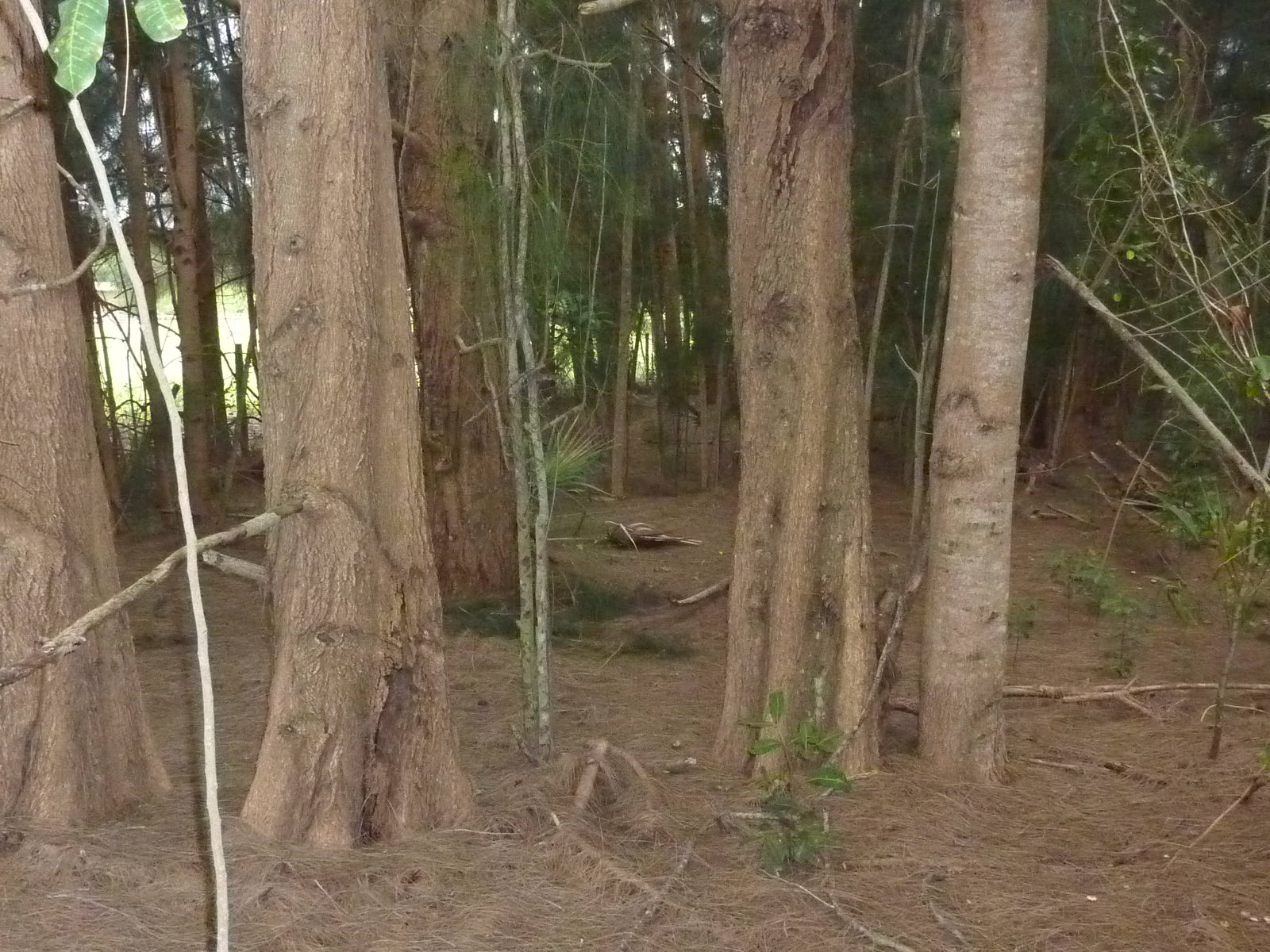
 This little forest was perhaps 100 yds by 100 yds. The perimeter was quite dense with new growth and saplings. But inside the perimeter, where little sun makes it through the thick canopy, hardly a weed or other plant was seen.  This is most unusual in Florida, where untended land is quickly overrun with all sorts of growth.
No Undergrowth
I considered that perhaps this wasn’t a conifer at all. So, back home, I widened my search to include all Florida trees.  Florida has over 300 native and 1000 exotic species, so this became a daunting task.  But the search did result in one article entitled “Identifying Invasive Australian Pine Trees”.  One more click and there was my mystery tree…the invasive Australian pine, also known as Ironwood, Beefwood and She Oak. The tree was described as deciduous, even though it remains green all year round.
This tree is quite unusual and a very aggressive competitor. First, in spite of its common name, it’s not a pine at all!   It is a Flowering Tree closer related to oaks than pines. The “needles” are actually branchlets with tiny scale-like leaves attached. The “cones” are actually a small nut-like fruit with winged seeds that are spread long distances by the wind.
But the most amazing feature of the Australian pine is its ability to take over existing habitats. The tree grows 5 to 10 feet a year and can reach 150 feet tall! The fallen branchlets and leaves contain a chemical that targets and inhibits the growth of other plants on the forest floor, so there is virtually no understory.  This phenomenon is called allelopathy. This most deplored survival strategy is similar to that used by the Roman general Scipio Africanus in 146 BC when he “salted the earth” of defeated Carthage, leaving the land sterile and uninhabitable.
Florida and Hawaii are currently the only states with stands of this invasive species. In another example of the Law of Unintended Consequences (and man’s shortsightedness), Australian pines were intentionally introduced here for lumber, canal stabilization and landscaping around 1900. In the past 15 years they have quadrupled their number in the wild, displacing more desirable Mangrove, Oaks and Palms.  Their shallow roots make them very susceptible to blow-over in storms, thereby destabilizing fragile shorelines.
This experience also proved once more I should not rely too heavily on common names or terms when identifying species.  “Pine” and “evergreen” are not synonymous. “Deciduous” and “broadleaf” are not the same. “Branches” can look like “needles”. “Fruit” can look like “pine cones”.  I really need to get a Tree Identifying Application from the app store.

Tuesday, July 5, 2011

The Cabbage Palm-Unsung Treasure of Florida


Cabbage Palm Grove
I’m not sure why we have an official Florida “State Tree”, but we do. It is the Cabbage Palm. One would expect that earning this title would place this palm on an honored and respected plane akin to the Bald Eagle or the Giant Sequoia, as it rightly should. But quite the opposite is true.  The Cabbage Palm, mainly because of its hardiness, or perhaps its name, gets no respect. In spite of its truly tropical appearance, landscape architects tend to shun the species in favor of more exotic ones. Virtually all other species of palm command higher prices as a landscape item. (Customer snob appeal enters the picture. Would you prefer to plant a “Silver” Palm, a “Royal” Palm, a “Washington” Palm, or a “Cabbage” Palm?)  Vast acreages of cabbage palms are lost every year through slash and burn clearing for suburban homes sites and new shopping. Fortunately, the palm is not endangered or threatened at this time.
The Cabbage Palm is found naturally in all parts of Florida.  Also known as the Sabal Palm, Palmetto Palm, or Sabal Palmetto, it is a survivor. Fossils have been found of Cabbage Palm fronds from 60 million years ago. It is extremely heat, cold, and draught and salt tolerant. The name Cabbage Palm comes from the edible and delicious heart of palm, or “cabbage” located at the top from where new growth develops. Unfortunately, harvesting the heart kills the tree and is banned in the US.  The Cabbage Palm is quite prevalent in some areas, with large forests consisting primarily of these palms. The flowers are yellowish-white, produced in large compound panicles up to 8 ft long, extending out beyond the leaves. Its fruit is a black berry about .5 in long containing a single seed.
Cabbage Palm in Full Bloom

Cabbage Palm Flowers
But is the Cabbage Palm really a tree?  Trees are classified as either Angiosperms (flowering plants), or Conifers (cone bearing).  All Palms are Angiosperms.  However, unlike most other trees, they are  members of a group called monocots, which produce seeds containing only one leaf. They are much closer related to wheat, rice, barley, sugar cane, bamboo and grass, than to oak or pine trees. The largest family in this group (and in angiosperms as a whole) is the orchid. But “tree” is not a scientific term. “Tree” generally means a woody plant, with a single trunk, and a minimum height at maturity of 12 feet or more. So the cabbage palm does indeed meet the tree definition.

Countless species of fauna and flora depend upon the Cabbage Palm for shade, protection and nourishment. Black bear, raccoons, bats, wild turkeys, white-tailed deer, gulls, cardinals, grackles, blue jays, and scrub jays all rely on the fruit for food.  As with most trees, the largest group of animal inhabitants is birds. Birds of many species will temporarily perch on a high frond while scouting food and predators. Many will build a nest in the top center where new fronds create a natural protected area.


But the features that set the palm apart from all other trees and provide a unique habitat are the “bootjacks”.  As the palm grows, new fronds sprout from the top where the heart is located. Old fronds below eventually die and turn brown. (A palm with dead fronds hanging down is said to be “bearded”.)  The lower of these will then break off, leaving the y shaped base of the frond still attached to the main trunk. These are called bootjacks. A small cavity, about the size of a small orange, exists where the boot meets the trunk. A typical palm will have hundreds of these micro dwellings.  Debris, in the form of dead leaves, pine needles, and airborne detritus and seeds will collect in many of these pockets. Add abundant rain in the summer and you’ve got a nursery for hundreds of flowers and plants. Small rodents, reptiles, birds and insects find this a made-to-order nest. 


Most of this symbiotic growth will die in the fall, when the dry season ceases the supply of rainwater.  But a large group of epiphytic plants, vines, and mosses survive in these pockets indefinitely. Most typical are air plants and ferns. This growth can become very dense and some palms will appear as if they are actually sprouting bushy new growth all up and down the trunk.

When a cabbage palm is transplanted for use in landscaping, it is heavily pruned, root cropped and usually de-booted. This produces an odd looking stalk, with a small root ball and a few wisps of greenery on top.
Surprisingly, most transplants survive. A tree can obtain a height of 80 feet or more, although 40 to 60 feet is most common. Some Cabbage Palms in natural surroundings will lose all their boots and the trunk will appear smooth. Some will keep all their boots and some will be partially booted. This appears to be a random phenomenon, and poorly understood. Tree health, environment, location and wildlife activity may be factors. Another unusual characteristic of the palms is their growth pattern. They will achieve almost full trunk diameter while still only 2 to 3 feet tall!  The outer “bark” is dead and all future growth will be vertical.
With all these variations in size and appearance, it is easy to misidentify. Florida has only eight native palms species (but many more imported exotics). “Native” is another term like “tree” that has a somewhat loose definition. A US “Native” plant is defined by Wikipedia as a plant that has been growing here since before colonization.
To ID a Cabbage Palm look for the fan shaped 6 foot leaves, which distinguish it from the Royal Palm which has huge 15 to 20 foot leaves. And there is a lack of a saw edge on the frond stalks. This will distinguish it from the much shorter Saw Palmetto. The smaller Buccaneer Palm will have rings on the lower trunk and the Everglades Palm grows in clumps. The Florida Thatch Palm and Keys Thatch Palm will have rounded and folded leaves. And lastly, the Needle Palm is a low growing palm with 4 -8 inch needle like spines produced between leaves.  (All other palm varieties have been imported from tropical and sub tropical lands.)  But if you forget all these characteristics, just play the odds. If you’re in Florida, and in the wild, and see a palm, the chances are pretty good it’s a Cabbage Palm.